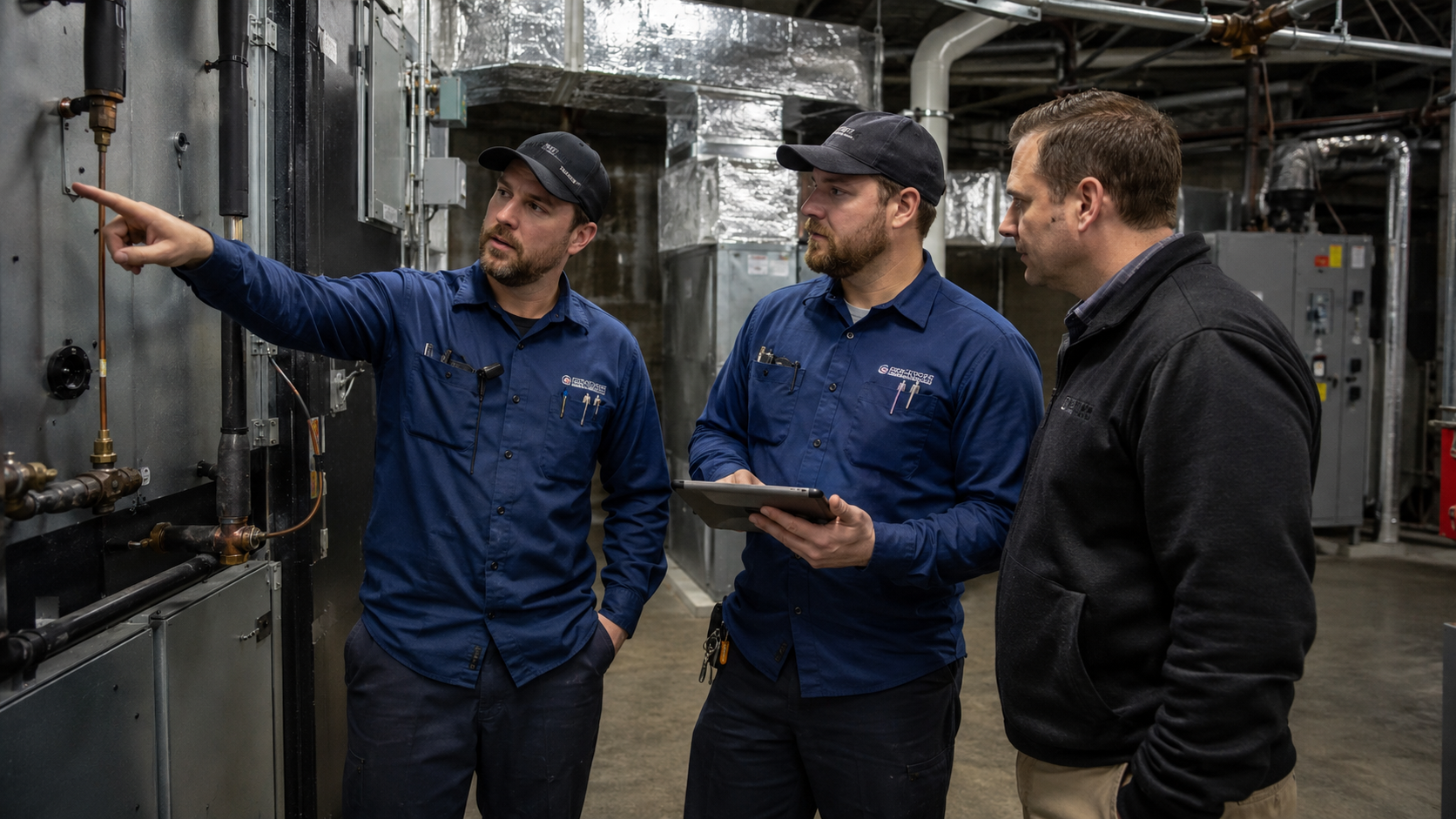
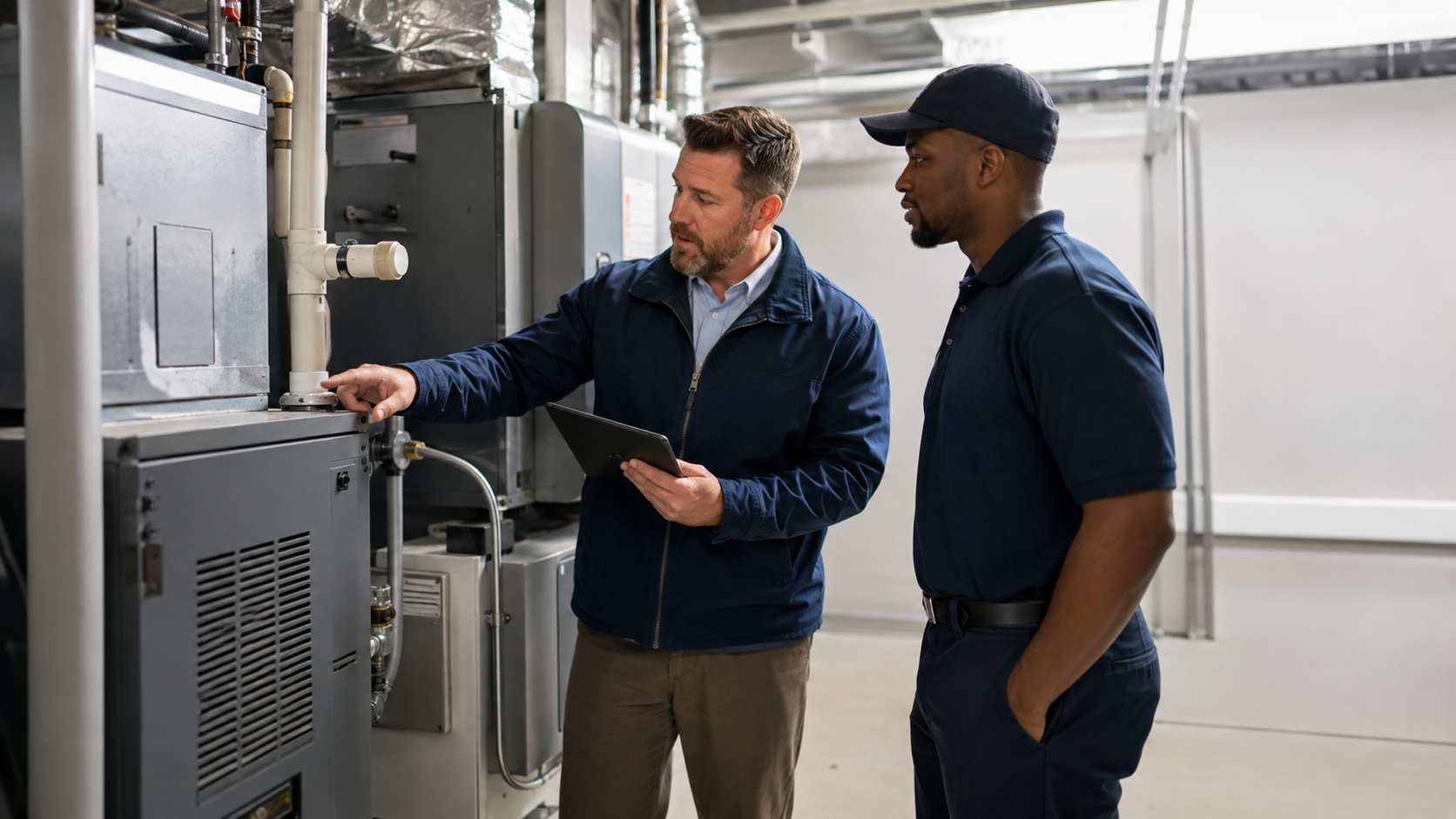
For a property manager, an HVAC failure is never just a mechanical problem. It becomes a tenant complaint, a maintenance ticket, a disruption for your team, and potentially an expensive emergency repair.
Across multiple units or buildings, those problems compound quickly. That’s why property management HVAC maintenance shouldn’t be treated as an optional expense that gets pushed until something stops working.
It’s medicine for the portfolio, not a vitamin you add when the budget allows.
A structured maintenance program helps you find small problems earlier, document equipment condition, plan replacements, and reduce the number of surprises your team has to deal with.
Why Reactive HVAC Maintenance Gets Expensive
Reactive maintenance means waiting until someone reports that the heat or air conditioning isn’t working.
By that point, the problem has already reached the tenant.
Emergency service is also harder to control than scheduled maintenance. You’re dealing with the timing of the failure, technician availability, tenant expectations, and potentially a system that’s been deteriorating for weeks or months.
In addition, equipment that’s allowed to run with unresolved problems may experience additional wear before it finally fails.
A preventative approach changes that.
Instead of asking:
“How quickly can we get this running again?”
You can start asking:
“What is beginning to fail, and when should we address it?”
That distinction matters across an entire portfolio.
Build HVAC Maintenance Into the Lease Cycle
One of the easiest ways to make property management HVAC maintenance more consistent is to connect it to events you’re already managing.
Unit turnover is an ideal opportunity.
When a tenant moves out, inspect the HVAC system before the next tenant moves in. This gives your team a chance to identify issues while the unit is vacant instead of discovering them after someone has already taken possession.
A turnover inspection can help document:
- Current system condition
- Filter condition
- Heating and cooling performance
- Thermostat operation
- Airflow
- Unusual noises or odors
- Visible drainage issues
- Equipment age
- Repairs that may be approaching
- Items that should be monitored during the next lease
That creates a baseline for the next occupancy period.
Seasonal transitions should also be part of the schedule.
Spring gives you an opportunity to evaluate cooling systems before summer demand increases. Fall does the same for furnaces and heating equipment before Illinois temperatures drop.
The goal is to find the problem during your schedule, not the tenant’s emergency.
Standardize HVAC Maintenance Across the Portfolio
Inconsistency creates blind spots.
One property gets a thorough inspection. Another gets a filter change and a quick visual check. A third gets serviced only when somebody complains.
Eventually, you have multiple buildings with no consistent picture of equipment condition.
A real property management HVAC maintenance program should establish a baseline for what gets inspected and documented across every applicable property.
ANSI/ASHRAE/ACCA Standard 180 provides a recognized framework for HVAC inspection and maintenance in commercial buildings. The U.S. Department of Energy’s Better Buildings Solution Center provides additional information on the standard.
Review ANSI/ASHRAE/ACCA Standard 180 through the Better Buildings Solution Center
The exact requirements for individual systems will vary. However, a recognized framework gives property managers something much more useful than a vague promise of “preventative maintenance.”
It gives you a standard.
Know the Difference Between an HVAC Vendor and a Maintenance Partner
A vendor fixes the problem in front of them.
A strong maintenance partner should also help you understand what’s coming next.
If a system is aging, repair frequency is increasing, or a major component is beginning to deteriorate, you should know before it becomes an emergency replacement.
That information changes how you budget.
Instead of discovering during peak season that a unit needs to be replaced immediately, you can begin planning the capital expense while the equipment is still operational.
A useful HVAC partner should help you understand:
- Which systems are performing normally
- Which systems need repairs now
- Which systems can be monitored
- Which equipment is generating repeat service calls
- Which units may be approaching replacement
- Where recurring complaints suggest a larger problem
- What should be included in future capital planning
The goal isn’t more service calls. It’s fewer surprises.
Document Every HVAC Inspection and Repair
Documentation protects more than the equipment.
Every service visit should create a usable record of:
- What was inspected
- What the technician found
- What was repaired
- What was cleaned or adjusted
- What equipment condition was observed
- What requires monitoring
- What may require future replacement
Over time, those records become an operating history for the portfolio.
That history helps answer important questions.
Which systems are costing the most to maintain?
Which units are producing repeat failures?
Are certain buildings generating more comfort complaints?
Is one piece of equipment becoming a capital risk?
Should another repair be approved, or is replacement starting to make more financial sense?
Without documentation, those decisions depend on memory.
With documentation, you have data.
Don’t Wait for Tenant Complaints to Find HVAC Problems
A tenant complaint often tells you that the problem has already progressed far enough to affect the space.
For example, the underlying issue could be:
- Restricted airflow
- A dirty filter
- A failing electrical component
- Drainage problems
- Thermostat issues
- Uneven distribution
- Refrigerant-related problems
- Equipment that’s struggling to maintain temperature
A proactive maintenance program is designed to catch signs like these earlier.
That reduces the chance that the first person to identify an HVAC problem is the person paying rent.
Your maintenance team should find the problem before your tenants have to.
Indoor Air Quality Is Part of HVAC Maintenance
Heating and cooling equipment doesn’t operate separately from indoor air quality.
Ventilation, filtration, humidity control, airflow, and system cleanliness all influence the indoor environment.
The EPA’s indoor air quality resources provide guidance on common indoor air concerns, while the CDC also provides information on indoor air quality.
For property managers, this means an HVAC maintenance program shouldn’t stop at asking whether the equipment turns on.
The system also needs to move, filter, heat, cool, and manage air as intended.
If tenants repeatedly report stale air, high humidity, unusual odors, or major temperature differences, those complaints may justify a closer look at the HVAC system and building conditions.
Use Maintenance Records for Capital Planning
One of the biggest benefits of consistent property management HVAC maintenance is visibility into future capital needs.
Equipment replacement shouldn’t come as a complete surprise if a system has been inspected and documented consistently.
Maintenance history can help identify:
- Increasing repair frequency
- Repeated electrical failures
- Declining system performance
- Corrosion
- Recurring refrigerant issues
- Airflow problems
- Aging equipment
- Parts becoming difficult to source
- Systems that are becoming increasingly expensive to keep running
That gives property managers time to communicate with ownership, evaluate replacement options, and budget appropriately.
A planned replacement is still an expense.
But it’s an expense you can manage.
An emergency replacement manages you.
What a Property Management HVAC Maintenance Program Should Include
A strong portfolio-wide program doesn’t need to be complicated.
It needs to be consistent.
Depending on the buildings and equipment involved, the program may include:
- Seasonal heating inspections
- Seasonal cooling inspections
- Filter schedules
- Electrical inspection
- Airflow checks
- Thermostat and control testing
- Coil inspection and cleaning
- Condensate drainage inspection
- Combustion and furnace safety checks where applicable
- Documentation after every visit
- Equipment condition tracking
- Repair history
- Replacement forecasting
The exact schedule should reflect the equipment, occupancy, building type, and operating conditions.
However, the principle stays the same:
Inspect consistently. Document what you find. Act before small issues become portfolio problems.
The Blue Collar Mechanical Approach
Blue Collar Mechanical works with property managers who need more than a technician who shows up when something breaks.
We bring commercial-level HVAC practices into the properties we service throughout Park Ridge and Chicagoland.
That means looking at the condition of the system, documenting what we find, and helping property managers understand what needs attention now versus what should be planned for later.
For a portfolio, that means greater consistency across units and buildings.
We want you to know:
- What’s working
- What’s beginning to wear
- What needs attention
- What can be monitored
- What’s generating repeat problems
- What may become a future capital expense
Clear documentation. Better planning. Fewer HVAC surprises across the portfolio.
Make Property Management HVAC Maintenance Proactive
The worst time to learn about an HVAC problem is when a tenant tells you the system has already failed.
A structured property management HVAC maintenance program puts your team ahead of that call.
Tie inspections to lease turnover. Schedule seasonal maintenance. Standardize what gets checked. Document every visit. Most importantly, use that information to plan repairs and replacements before the equipment decides the timing for you.
Don’t manage HVAC failure. Manage the system before it fails.
Talk to Blue Collar Mechanical about a portfolio-wide HVAC maintenance program or call (800) 804-6546.
Blue Collar Mechanical provides residential and commercial HVAC service throughout Park Ridge and the greater Chicagoland area.
Sources
U.S. Department of Energy Better Buildings Solution Center — ANSI/ASHRAE/ACCA Standard 180