
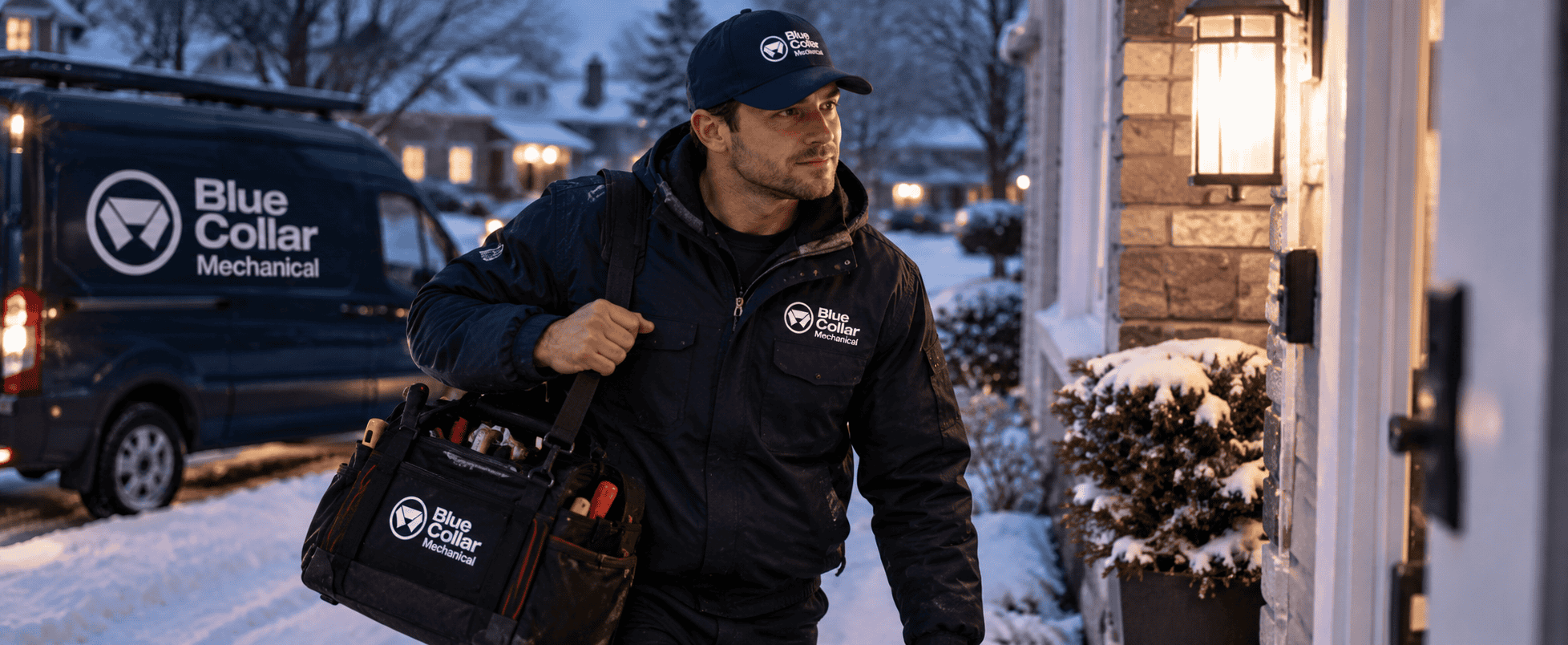
Most service calls blend together after a while. A furnace will not start, the AC is not cooling, or there is a strange noise coming from the vents.
But every once in a while, a service call reminds you why the details of this job actually matter, and why treating HVAC service as urgent, necessary work, medicine, not a vitamin, is not just a marketing line.
In this case, careful inspection helped keep a family safe.
What Happened During This Service Call
We were called out to a home in the middle of winter for a furnace that had stopped producing heat.
On the surface, it looked like a routine no heat call, the kind we run all winter. However, during the inspection, our technician found something more serious: a cracked heat exchanger.
This type of failure can allow carbon monoxide to enter a home’s air supply.
The family had a working carbon monoxide detector, but it had not alarmed yet. The leak was still at an early stage.
If that furnace had kept running even a short while longer without being caught, the outcome could have been very different.
Why This Service Call Changed How We Think About the Job
It is easy to think of a no heat call as a comfort issue. It may seem inconvenient and uncomfortable, but not necessarily urgent in a life or death sense.
That service call reminded us that HVAC systems are not just comfort appliances. They are combustion equipment, electrical systems, and safety systems running quietly in the background of people’s homes.
The EPA and CDC, both linked below, are direct about the real health risks of poorly maintained combustion appliances. That call made those statistics feel a lot less abstract.
What We Changed Because of It
After that call, we became more deliberate about combustion and safety inspections during every furnace visit. We do not treat them as a box to check. Instead, we treat them as the single most important part of the inspection.
We also talk more openly with homeowners about what a cracked heat exchanger actually means and why it is not a repair to delay.
Most importantly, we treat every routine sounding no heat call with the seriousness it deserves. You do not know which one is routine and which one is not until you have actually looked.
Why This Service Call Matters
We are not telling you this to scare anyone. Carbon monoxide leaks from HVAC systems are relatively rare precisely because proper maintenance and safety inspections catch them before they become dangerous.
We are sharing this story because it is one of the clearest examples of why maintenance and inspection are not optional extras.
They are the medicine that prevents the worst outcomes, not a vitamin you get around to eventually.
It is the same reasoning behind our full breakdown of What We Wish More Homeowners Knew About HVAC Service. Some of what feels like routine advice exists because we have seen what happens when it is ignored.
What This Means for Your Home
If your furnace is more than a few years old and has not had a combustion safety inspection recently, it is worth addressing before it becomes urgent in the way that call was.
A working carbon monoxide detector is essential. However, it is your last line of defense, not your first.
The first line of defense is a furnace that has been inspected by someone trained to catch the kind of failure that does not always announce itself.
That family is safe today because a routine sounding service call got treated with real seriousness. That is the standard we hold every visit to, whether it looks routine or not.
Schedule a furnace safety inspection with Blue Collar Mechanical: https://www.trybluecollar.com/ (800) 804-6546
Sources:
https://www.epa.gov/indoor-air-quality-iaq/publications-about-indoor-air-quality